

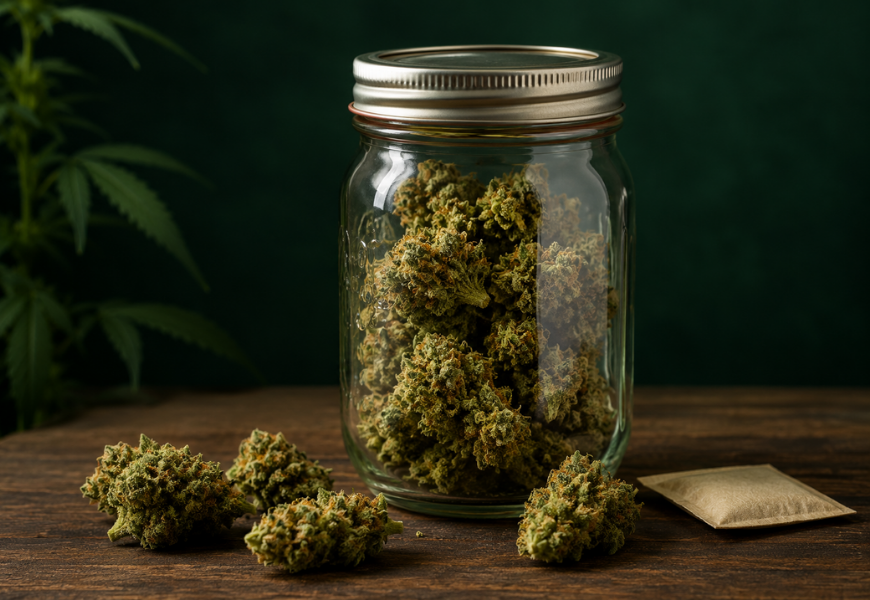
Yes, mason jars are genuinely good for dry herb storage. Glass is non-porous, so it does not absorb odor or react with terpenes the way plastic does. A tight rubber-gasket lid creates an effective airtight seal that keeps moisture stable and locks smell in. For the price, it is one of the most reliable options available.
Why Glass Works Well
Glass has a few specific advantages over other common storage materials:
- Non-reactive. Will not leach chemicals or flavors into your flower, even over months.
- Non-porous. Unlike plastic, glass does not absorb odor or residue from previous stashes.
- Transparent (or tinted). You can check your flower without opening the lid, though clear glass should be kept in a dark place to block UV light.
Plastic bags and containers are the most common storage mistakes. Plastic generates static that pulls trichomes off your bud, and cheaper containers rarely seal well enough to hold humidity. A mason jar fixes both for a couple of dollars.
What Size Jar to Use
Choosing the right size matters. Too much empty air dries your flower out faster. Too little headspace compresses buds.
|
Amount |
Recommended Jar Size |
|
3.5g (an eighth) |
Half-pint (8 oz) |
|
7g (a quarter) |
Half-pint (8 oz) |
|
14g (a half ounce) |
Pint (16 oz), wide-mouth |
|
28g (a full zip) |
Pint (16 oz), wide-mouth |
Wide-mouth jars make it easier to place and remove buds without crushing them. Fill about two-thirds to three-quarters full so there is a small air pocket but not too much dead space.
Curing in a Jar (Burping Explained)
Mason jars are not just for storing cured flower. They are the standard tool for curing fresh-trimmed buds too.
How to cure in a glass jar:
- Place trimmed, partially dried buds into the jar, about two-thirds full.
- Seal the lid and store in a cool, dark spot.
- Burp the jar once or twice a day for the first one to two weeks.
- After two weeks, reduce burping to every few days as the buds stabilize.
What burping means: you open the lid briefly to release trapped moisture and gases, then reseal. This controlled air exchange lets buds cure evenly without building up enough moisture to invite mold.
If the jar smells like ammonia when you open it, the buds were too wet when jarred. Take them out, air dry for a few hours, and re-jar.
Mason Jar vs. Dedicated Storage Products

A mason jar handles the basics well, but it has limits. Here is how it stacks up against purpose-built stash jars:
|
Feature |
Mason Jar |
Dedicated Stash Jar |
|
Airtight seal |
Yes (rubber gasket) |
Yes (silicone or rubber) |
|
UV protection |
No (clear glass) |
Often (tinted or opaque) |
|
Odor containment |
Good |
Good to excellent |
|
Humidity control |
No (manual only) |
Some include packs |
|
Portability |
Bulky, fragile |
Compact, often padded |
The biggest gap is humidity control. A mason jar keeps air out but does not regulate moisture inside. Pairing it with a two-way humidity pack closes that gap and gives you the classic combo experienced users rely on.
If you want UV protection without buying a new container, store the jar inside a cabinet or drawer. Problem solved for free.
For a more portable, purpose-built option, Grasscity carries a range of stash jars, tins, and boxes designed specifically for flower storage.


