

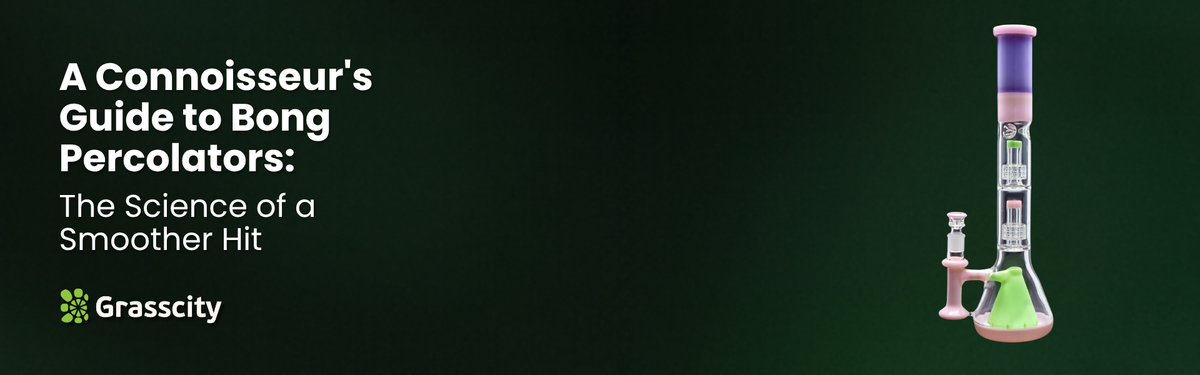
A bong percolator works by forcing smoke through many small holes or slits, breaking one large bubble into thousands of tiny ones. That massive jump in surface area cools and humidifies the smoke fast, which is what makes a percolator bong hit smoother and less harsh than a plain tube.
A percolator diffuses smoke into small bubbles for maximum contact with water, cooling and humidifying the hit. It doesn't filter out THC or make smoke "safe," it just makes it more comfortable to inhale. More percolation means smoother hits but also more drag, so there's a real tradeoff to consider.
What a Percolator Actually Does
A percolator, or "perc," is a water diffuser built into a bong with one core purpose: creating more bubbles. That's not just for visual effect. Breaking smoke into many small bubbles instead of one large one is the entire mechanism behind why percolator bongs feel smoother than basic ones.
The Science: How Percolators Filter and Cool Smoke
The principle behind a percolator comes down to surface area. Think about ice in a drink: a single large cube cools slowly, while a handful of crushed ice cools almost instantly, because crushed ice has far more surface area in contact with the liquid. A percolator does the same thing to smoke, shattering it into thousands of small bubbles that maximize contact with water.
That contact does three things:
- Cooling. More surface area means faster heat transfer, so the smoke drops in temperature quickly as it passes through.
- Humidifying. Hot, dry smoke is a major cause of coughing. Water bubbling through a percolator adds moisture, making the hit noticeably less harsh on your throat.
- Trapping particulates. Water also acts as a physical filter, catching some ash and larger byproducts as smoke passes through, which is part of why bong water gets dirty over time.
It's worth being direct about what a percolator doesn't do. A bong isn't a medical filtration device, and percolation doesn't remove all harmful compounds from smoke. It also doesn't affect potency. Cannabinoids like THC aren't water-soluble, so they pass through percolation largely unaffected. Any minor potency difference some smokers notice usually comes down to condensation on the glass, not the percolator filtering anything out.
Main Types of Percolators
There are several common percolator styles, each with a different balance of smoothness and airflow.
|
Percolator Type |
Diffusion |
Drag |
Best For |
|
Honeycomb |
High |
Moderate |
Smoothness with manageable resistance |
|
Tree |
High |
Higher |
Maximum filtration, more cleaning upkeep |
|
Showerhead |
Moderate |
Low |
Beginners wanting an easy draw |
|
Inline |
Moderate |
Low |
Simple, effective first-stage filtration |
|
Matrix |
Very high |
High |
Smoothness seekers who don't mind extra drag |
|
Turbine/Recycler |
Moderate |
Low-moderate |
Visual appeal plus splashback control |
A few quick notes on each style:
- Honeycomb uses a flat disc full of small holes, creating dense diffusion without the drag of a full tree design.
- Tree percolators use multiple branching arms, and more arms generally means more filtration, but also a longer, harder cleaning process.
- Showerhead percolators disperse smoke through slits around a central tube, offering a good balance for beginners who don't want a heavy pull.
- Inline percolators sit horizontally and offer solid first-stage filtration with very little added resistance, often paired with other perc types.
- Matrix percolators combine vertical and horizontal slits for some of the most intense diffusion available, at the cost of the most drag on this list.
- Turbine and recycler styles focus as much on visual effect as function, creating a spinning or looping water motion that also helps reduce splashback.
Each of these styles has enough depth to warrant its own explainer. For a full breakdown of any single type, our percolator-specific guides cover the details rather than repeating them here.
Does More Percolation Always Mean Smoother Hits?
Not necessarily, and this is one of the most common misconceptions about percolator bongs. More percolation does generally mean more diffusion and a cooler hit, but it comes with a real tradeoff called drag, the amount of resistance you feel when inhaling. Forcing smoke through more holes and chambers takes more lung effort, similar to pulling a thick drink through a narrow straw instead of a wide one.
A heavily percolated piece, like one with a matrix or multiple tree percs stacked together, can produce an exceptionally smooth hit, but only if you're able to comfortably pull enough air through it. For many smokers, a single well-designed percolator, like a showerhead or honeycomb, delivers most of the smoothness benefit without the extra effort.
Percolator vs. No Percolator: Is It Worth It?
Whether a percolator is worth adding to your setup depends on what you're prioritizing in a session.
Reasons to go with a percolator:
- You smoke frequently and want to reduce throat irritation over repeated sessions.
- You prefer cooler, more comfortable hits over raw airflow.
- You don't mind a bit of extra cleaning in exchange for smoother hits.
Reasons a plain tube might suit you better:
- You want the easiest possible draw with minimal resistance.
- You prefer simpler cleaning and fewer glass chambers to maintain.
- You're an occasional smoker who doesn't notice much difference in harshness either way.
Neither option is objectively better, it's a genuine tradeoff between smoothness and simplicity. Many smokers land somewhere in the middle with a single percolator rather than a heavily stacked design.
Percolator Bongs Worth Considering
If you're shopping based on what you've just learned, matching the percolator type to your priorities matters more than chasing the most complex design available. Grasscity's percolator bongs collection covers the full range, from simple showerhead and inline styles to more advanced honeycomb and matrix pieces.
The Bottom Line
A percolator's job is simple: break smoke into smaller bubbles to cool and humidify it for a smoother hit. It won't change your potency and it won't make smoke "safe," but it will make the experience more comfortable, especially for daily smokers. The right amount of percolation comes down to balancing smoothness against drag, not just picking the most complex piece available.


