

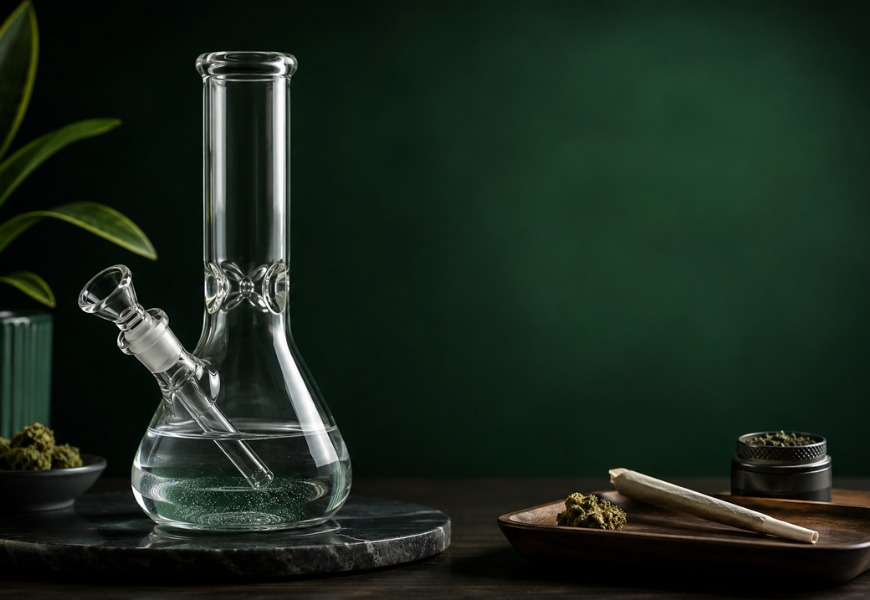
A bong changes how smoke feels, not what combustion produces. Water cools the smoke and traps some larger particles before they reach your mouth and throat, but combustion still creates tar and other byproducts. The biggest difference between a bong and a joint is the smoking experience, not the combustion itself.
A bong and a joint both involve burning dry herb, but they deliver the smoke differently. A bong passes smoke through water before it reaches you, which cools it and traps some larger particles. A joint delivers smoke directly without filtration. Here's what those differences actually change and what they don't.
How Water Filtration Changes the Smoking Experience
The water in a bong does two things well:
- Cools the smoke: Lower temperatures can mean less irritation when the smoke reaches your throat and lungs, which is why bong hits tend to feel noticeably smoother than a direct draw.
- Traps larger particles: Some ash, debris, and water-soluble compounds get caught in the water before they reach your airways.
What it doesn't do:
-
Filter out tar or carcinogens: Those are produced when plant material combusts, and water does not remove them completely. They pass through just fine.
What the research actually says
Some water-pipe filtration research has found reductions in certain smoke compounds, but not enough to make water pipes a health tool. It's also worth noting that most published studies focus on tobacco smoke rather than dry herb, so findings shouldn't be treated as a direct match.
The takeaway is simple: water filtration changes how the smoke feels, but combustion still produces the same fundamental byproducts.
What percolators add
Percolators take this a step further by forcing smoke through additional water contact points, which increases diffusion and makes the hit feel even smoother. Percolators increase water contact, making each draw cooler and smoother. They improve the feel of the hit, but they don't change the fact that the smoke comes from burning dry herb.
Bongs vs. Joints vs. Bowls: How They Actually Compare
|
Factor |
Bong |
Joint |
Bowl/Pipe |
|
Hit smoothness |
Smoothest, water cools and filters |
Harshest, no filtration, paper combustion adds to it |
Moderate — no paper burn, but no filtration either |
|
Throat irritation |
Low |
High |
Moderate |
|
Portability |
Low, needs water and setup |
High, roll it, pocket it |
High, pack and go, no water needed |
|
Shareability |
Low-moderate one mouthpiece |
High, easy to pass around |
Moderate, shared bowl, one piece |
|
Setup required |
Yes water, bowl, lighter |
Minimal papers, herb, lighter |
Minimal pack and light |
|
Taste clarity |
High water helps preserve flavor |
Variable paper adds its own taste |
Good no paper interference |
|
Smell during sesh |
Lower water traps some particles |
Strongest open burn and paper combustion |
Moderate |
Bongs vs. Joints: How the Smoking Experience Feels
If you've used both, you already know this difference.
What a joint does to the smoke
- Burns continuously at the tip, producing hot, direct smoke from the moment it's lit
- The rolling paper combusts too, adding extra byproducts to each inhale
- No filtration between the cherry and your throat, what burns reaches you directly
What a bong does differently
- Pulls smoke through water before it reaches you, dropping the temperature noticeably
- Larger ash particles and some debris get trapped in the water rather than traveling further
- The hit arrives cooler and smoother, that's just the physics of passing hot gas through liquid
One practical difference is that a bong encourages larger single draws. Filling and clearing the chamber often means inhaling more smoke at once than you would from a typical joint puff.
Not sure which water pipe style suits your setup? The types of bongs guide breaks down the difference between beakers, straight tubes, and percolators, and how each one affects the hit differently.
How the Experience Can Feel Different
Not in any meaningful way that comes down to the method itself.
The effects depend on:
- How much you consume in a given session
- The potency of your dry herb
- How your body responds which varies person to person
The delivery method doesn't change the compounds in your dry herb, but it can change how each draw feels. A bong often delivers a larger volume of smoke in a single inhale, while a joint spreads the session across smaller draws. That difference can make the experience feel different from one method to the other.
Many people associate bongs with a stronger first draw because they typically involve clearing a larger chamber of smoke at once.
Smell Comparison
During the sesh
- Bongs: Lower smell overall. Water traps some odor-causing particles, and there's no continuously burning paper adding to the room's air.
- Joints: The strongest and most obvious. A joint burns from the moment it's lit whether or not you're actively drawing, which means continuous odor and paper combustion smell.
- Bowls/pipes: Somewhere in the middle. No open burn between draws since the bowl only burns when you're actively pulling, but no water filtration to catch particles either.
After the sesh
- Bong water that sits for even a few hours develops a distinct, musky odor that can be worse than the smell of the session itself.
- Change the water regularly and this isn't an issue, but it's worth knowing before you leave a used bong sitting overnight.
- Joints and pipes don't carry the same lingering water-odor risk, but residue in the bowl or paper ash can contribute to stale smells in the space.
Which Smoking Method Fits Your Style?
There's no objectively better method. It comes down to what you value for a given situation.
If smoothness matters most, choose a bong. If convenience matters most, choose a joint. If you want something simple without rolling papers or water, a pipe sits right in the middle.
Go with a bong if:
- You want the smoothest, coolest hit possible
- You're mostly at home with no need to pack up and go
- You don't mind a quick setup, fill with water, pack the bowl, go
If you're new to water pipes and not sure where to start, our bong starter kit guide covers what to look for, how joint sizes work, and how to avoid the most common first-buy mistakes. Browse the full bongs collection when you're ready to pick a piece.
Go with a joint if:
- You want something portable, shareable, and low-maintenance
- No gear to clean, no water to change, just roll, light, and pass
The paper you choose matters more than most people realise. Our rolling papers selection guide breaks down the real differences between hemp, rice, and wood pulp, each burns and tastes differently. For a quicker material breakdown, the hemp vs. rice vs. wood pulp comparison covers it concisely. Shop the full rolling papers range from RAW, OCB, Zig-Zag, and more.
Go with a bowl or pipe if:
- You want the simplicity of no rolling and no water
- Pack it, light it, done pocketable, zero prep, and easy to share


