

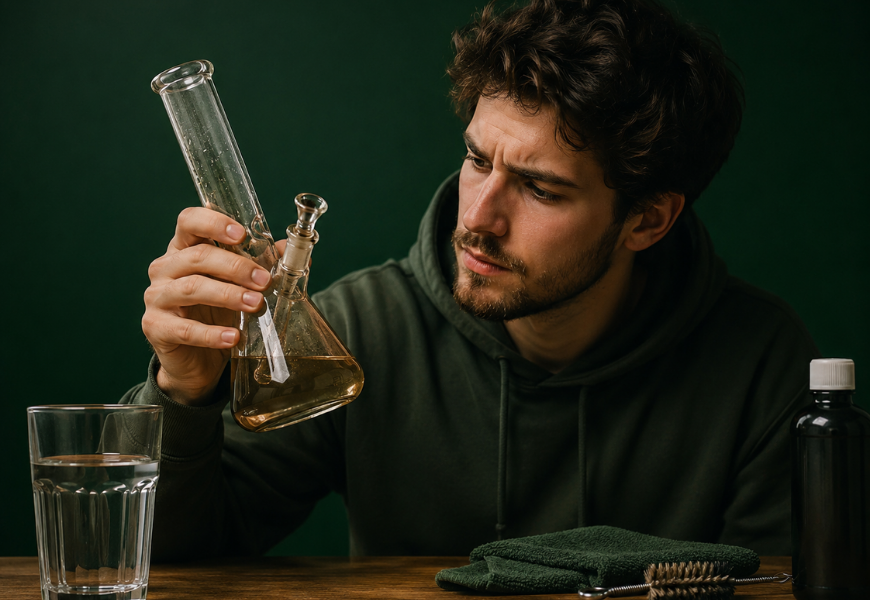
You technically can drink bong water, but you shouldn't. It's loaded with tar, resin, ash, and bacteria, so at best it tastes disgusting, and at worst it can upset your stomach. It will not get you high. Here's what's actually in it, what happens if you swallow some, and how to keep it from becoming a real problem.
Bong water is the liquid sitting in the base of a water pipe. It filters and cools smoke as it passes through, collecting everything the smoke leaves behind.
That collecting is exactly why swallowing it is a bad idea. Let's break down what's actually in there.
What's Actually in Bong Water
Every hit that bubbles through your bong leaves something behind. That murky brown liquid isn't just "dirty water," it's a small chemistry set of combustion byproducts:
- Tar: the sticky, dark residue left over from burned plant matter
- Resin: the same gunk that coats your bowl and downstem, just suspended in liquid form
- Ash: fine particulate that settles at the bottom
- Bacteria and mold: start multiplying once the water sits for a while
None of this is exotic or mysterious. It's the same reason a glass left out for a few days grows a film, except this water was actively filtering smoke the whole time, so it's collecting more than dust.
Related: see exactly how this buildup wrecks your taste and smell.
Will Drinking It Get You High? (No, Here's Why)
This is the myth worth killing outright: no, drinking bong water will not get you high.
Here's the actual mechanism. THC and other cannabinoids are lipophilic, meaning they bind to fat, not water. When smoke bubbles through the water, almost none of the cannabinoid content transfers into the liquid itself. The water is filtering out ash and tar, not "storing" your high for later.
So if someone swears they felt something after a swallow of bong water, it's almost certainly one of two things:
|
What people think happened |
What's actually happening |
|
"I got a mini high from it" |
Placebo effect / expectation |
|
"It hit me weird" |
Mild nausea from bacteria or bad taste, mistaken for a high |
Nothing psychoactive is transferring into that water in any meaningful amount.
Health Risks of Old or Dirty Bong Water

It's easy to swing too alarmist or too casual here, so let's keep it simple: the risk depends entirely on how old the water is.
|
Scenario |
What's likely to happen |
|
One accidental swallow (a stray splash, a rip gone sideways) |
Bad taste, mild nausea, upset stomach that clears up on its own |
|
Water sitting for a day or two |
Bacteria starts developing; higher chance of stomach upset |
|
Water sitting for days or longer |
Active bacteria and mold growth; real risk of gastrointestinal illness |
Why this holds up: standing water at room temperature is a known contamination risk in general food safety science. While there aren't studies on bong water specifically, general guidance from the CDC and EPA notes that stagnant water can support bacterial growth. The same basic microbiology applies to water left sitting inside a bong, even though those recommendations aren't cannabis-specific.
Bottom line: don't panic over one accidental sip. Do treat week old bong water as a genuine reason to change it, not just a smell problem.
How Often You Should Change Your Bong Water
The fix here is almost embarrassingly simple.
- Best practice: change the water after every sesh.
- Minimum: change it at least once every 24 hours if you're using it daily
- Never let it sit longer than 2–3 days, even if the bong isn't in active use
- Use filtered or distilled water when you can, since tap water minerals accelerate buildup and residue
If you want your bong doing double duty as a water storage container, it's the wrong appliance for the job. Fresh water in, dirty water out, every time.
Once you're keeping the water fresh, the glass itself needs attention too. Here's how to clean your bong without leaning on isopropyl, and if it's been a while, our deep-cleaning guide covers percolators and stubborn resin.


