

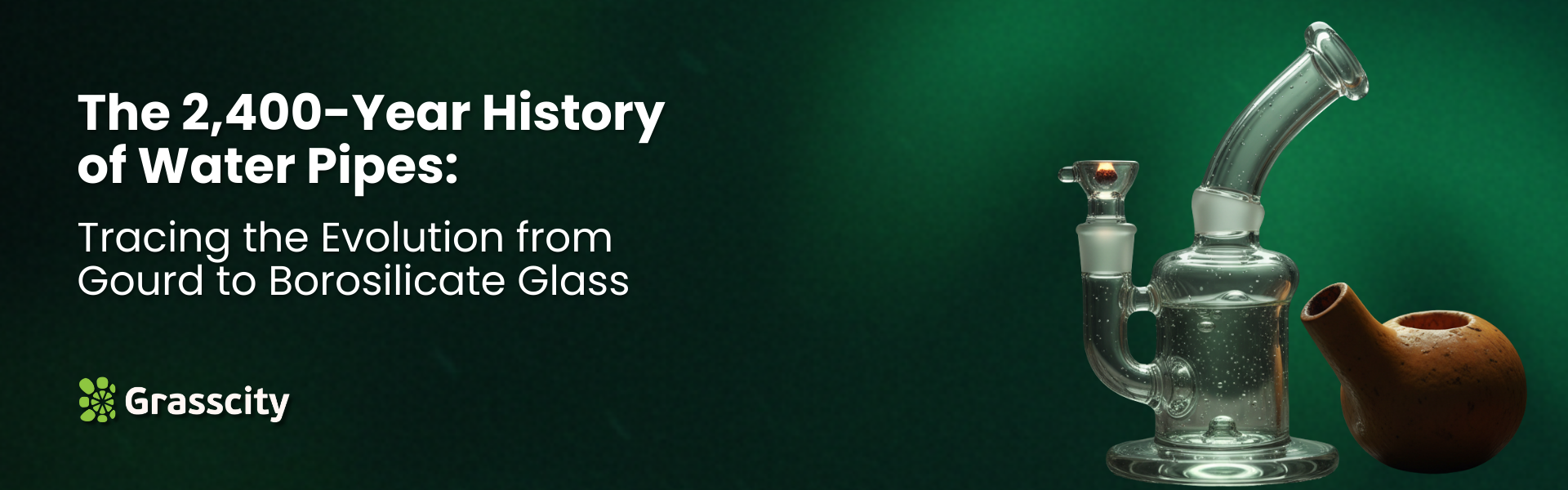
The water pipe, a cornerstone of modern smoking culture, possesses a history that stretches back over 2,400 years and across multiple continents. When you think of a bong today, your mind likely pictures the intricate modern glass showpieces found at Grasscity, complete with complex features like honeycomb percolators and ice catchers designed for the smoothest hits. But long before the invention of durable, lab-grade borosilicate glass, our ancestors crafted functional water pipes from organic materials like gourds, bamboo, and animal horns.
evolution from simple, earth-made tools to the scientific glass art of today is a story of human ingenuity. As pioneers in the online headshop space since 2000, we at Grasscity have seen this evolution firsthand and appreciate the deep roots of our flagship products. The journey of the water pipe is a global narrative, spanning from ancient tribes in Africa and Asia to the counterculture glass blowers who revolutionized the craft. To truly appreciate the device sitting on your coffee table, we must first travel back in time to where the story of water filtration began.
The Earliest Pipes: Nature's Ready-Made Tools
The first water pipes were crafted not in a workshop, but by nature itself, with evidence pointing to early use in African and Asian societies. Long before the invention of glassblowing, ancient smokers discovered the fundamental principle of water filtration using organic, readily available materials. These primitive devices were built around a simple concept: a hollow chamber to hold water and a stem to draw smoke through it, cooling and filtering the inhalation.
This innovation marked the birth of the bong, demonstrating a sophisticated understanding of airflow and smoke filtration. The ingenuity of these early creators lay in their ability to see a tool in the world around them, turning common natural objects into functional smoking apparatuses.
The most common materials used for these ancient smoking devices included:
- Gourds: The hollow, naturally waterproof shape of a dried gourd provided a perfect pre-made water chamber, requiring only the addition of a stem and a bowl.
- Bamboo: Stalks of bamboo offer a durable and easily workable material. Its hollow, segmented structure was ideal for creating the body of the water pipe, with smaller pieces used for downstems.
- Animal Horns: In regions where large animals were prevalent, hollowed-out horns served as another robust and convenient option for the main chamber of a water pipe.
These simple, organic instruments established the core concept of water-cooled smoke, a technological leap that set the stage for more refined and durable designs to emerge across different cultures.
What were the first water pipes made of?
The earliest water pipes were crafted from naturally hollow and water-resistant organic materials such as gourds, bamboo stalks, and coconuts. These items were ideal because their existing shapes required minimal modification to become functional smoking devices. The specific material used by ancient peoples depended entirely on the local resources available to them. In many regions of Asia, the segmented and hollow structure of bamboo made it the perfect choice for constructing both a water chamber and a stem. Similarly, in parts of Africa and the Americas, dried gourds offered a naturally bulbous and waterproof body that was easily converted into a water pipe.
The fundamental principle was universal: find a vessel that could hold water, attach a tube for a stem, and create a bowl for the herb. This resourcefulness demonstrates the simple ingenuity behind the first water pipes, which were born from the environment itself. While effective, these organic materials were not built to last, which prompted the search for more durable substances as metalworking and pottery skills developed.
The Scythian Connection: Ancient Gold Bongs
The transition from organic materials to more permanent ones is highlighted by the existence of 2,400-year-old solid gold water pipes found in southern Russia. These ornate artifacts, unearthed from a Scythian burial mound, provide the most concrete evidence of ancient water pipe use. The Scythians, formidable nomadic warriors of Eurasia, were not only masters of horseback warfare but also practitioners of sophisticated smoking rituals where they consumed herbs like cannabis.
These ancient Scythian bongs were not simple, functional items; they were crafted from precious metal, indicating that smoking held a significant, perhaps even ceremonial, place in their society. This remarkable find shows that the fundamental design of the water pipe has remained consistent for millennia and that early cultures invested significant resources into creating durable, high-quality smoking devices. The existence of ornate, precious metal bongs illustrates a high level of craftsmanship, a practice that would continue to evolve as it spread across the globe.
The Rise of the Hookah: A Cultural Phenomenon

The evolution of the water pipe took a significant social turn with the emergence of the hookah in the 15th or 16th century, originating in either Persia or India. Known also as the narghile or shisha, this new design transformed the act of smoking into a communal experience. Unlike the direct-inhalation bong, the hookah was designed with one or more hoses, allowing multiple people to partake from the same vessel simultaneously. This innovation turned the water pipe into a cultural centerpiece, becoming a fixture in coffee houses and social gatherings throughout the Middle East and South Asia for centuries.
The hookah operates on a different principle than a typical bong; instead of direct combustion of dry herb, it uses charcoal to heat specially prepared flavored tobacco, producing a smoother, aromatic vapor. This shift from a personal device to a shared social apparatus highlights a major divergence in the history of water pipes, emphasizing ritual and community over solitary use. This tradition of social smoking would continue to flourish, while in other parts of the world, the focus would shift back toward material innovation and personal use.
What's the difference between a bong and a hookah?
The primary difference between a bong and a hookah is their intended use, heat source, and the substance smoked; bongs are typically for direct, individual inhalation of dry herb using a flame, while hookahs are designed for slower, social sessions with flavored tobacco heated by charcoal. Although both are types of Water Pipes that utilize water to cool and filter smoke, their function and cultural context are distinct. A bong is built for quick and efficient sessions, where a user directly ignites dry herb in a bowl for a concentrated hit.
It is fundamentally a personal smoking device. In contrast, a hookah is a social centerpiece, often featuring multiple hoses so several people can smoke at once. The substance used, known as shisha, is a wet, flavored tobacco that is not burned directly but heated by placing hot coals on top of the bowl. This indirect heating method produces a smoother, more flavorful smoke suitable for leisurely, extended gatherings. Understanding these distinct designs is key to tracing how different cultures adapted the water pipe for unique social and personal uses.
The Modern Era: How Glass Changed Everything
The 20th century marked a pivotal shift in water pipe construction, with the introduction of borosilicate glass transforming the functional smoking device into a form of intricate art. This revolution was spearheaded by the legendary glassblower Bob Snodgrass, who is widely regarded as the godfather of the modern glass pipe movement. Traveling with counterculture icons like the Grateful Dead, Snodgrass didn't just sell pipes; he popularized the use of durable, heat-resistant borosilicate glass as the ideal medium. This material offered a pure, clean taste and a transparent canvas that allowed for unparalleled creativity.
His work ignited a cultural phenomenon, giving rise to "heady glass"—one-of-a-kind, artistic pieces celebrated for their complexity and aesthetic value. This movement created a distinction between ornate, collectible art and the clean, function-focused designs of pieces like scientific bubblers. Snodgrass and his followers established glass as the gold standard for high-quality bongs, turning a simple tool into a personal statement. The artistic explosion of heady glass was paralleled by a scientific one, as glassblowers began incorporating complex features designed to perfect the smoking experience through advanced filtration.
Who is Bob Snodgrass?
Bob Snodgrass, widely known as the "Godfather of Glass," is the pioneering American artist credited with revolutionizing glass pipe making by inventing the technique of "fuming." Before his innovations in the 1970s and 80s, glass pipes were primarily simple, clear, and functional. Snodgrass discovered that by vaporizing small amounts of gold and silver in the flame during the glassblowing process, he could trap the fumes inside the borosilicate glass. This process, fuming, imparts a remarkable, color-changing quality to the finished piece.
A fumed Bob Snodgrass bong might initially appear to have a light yellow or blue tint, but as it is used and resin accumulates, it refracts light differently, revealing a vibrant spectrum of deep blues, purples, and pinks. This single innovation transformed a simple pipe into a piece of psychedelic art that evolved with its owner. By sharing his techniques while traveling with the Grateful Dead, he inspired an entire generation of artists and single-handedly created the foundation for the modern heady glass movement. Snodgrass's artistic work laid the groundwork for future glassblowers who would apply similar creativity to not just the look, but the scientific function of the bong.
Why is Borosilicate Glass Used for Bongs?
Borosilicate glass is the preferred material for high-quality bongs due to its
exceptional durability, clean taste, and high resistance to thermal shock, which prevents cracking from rapid temperature changes. This is the same type of "lab-grade" glass used in scientific settings, chosen for its ability to handle extreme and sudden shifts in temperature. When you light a bowl, the glass heats up instantly; regular glass would crack under this stress, but borosilicate glass is specifically engineered to withstand it.
This resistance to thermal shock ensures your piece is long-lasting and reliable. Furthermore, borosilicate glass is non-porous, meaning it won't absorb odors or residues after cleaning, providing a pure and untainted flavor with every session. The strength of the material also allows for more intricate and creative designs. This superior material not only makes for a durable, long-lasting piece but also enables glassblowers to craft more complex internal structures, like percolators, that further enhance the smoking experience.
The Changing of Design: From Simple Tubes to Scientific Marvels
The modern bong has evolved far beyond its simple tube-like ancestors, transforming into a piece of scientific equipment designed for the ultimate smoking experience. Driven by a desire for smoother, cooler, and more filtered hits, glassblowers began integrating complex features that manipulate the physics of smoke and water. This scientific approach to bong design has introduced a host of innovations that are now standard in high-quality pieces. The goal of this evolution is singular: to maximize the diffusion of smoke through water, which cools it for a smoother experience.
Features that were once considered high-end are now accessible to the everyday smoker, reflecting a market that values both aesthetic appeal and superior function. As a pioneer in the industry for over two decades, Grasscity has been at the forefront, curating a selection that showcases this incredible journey from basic functionality to sophisticated scientific design. This focus on function has led to the development of several key components that define the modern water pipe.
What are percolators and ice catchers?
In modern scientific bongs, percolators are internal glass structures that diffuse smoke through water for enhanced filtration, while ice catchers are indentations in the bong's neck that hold ice cubes for cooling. Both features are designed to cool and filter the smoke, creating a smoother experience.
A percolator works by forcing the smoke through numerous small holes, breaking it down into smaller bubbles. This process dramatically increases the surface area of the smoke that interacts with the water, resulting in significant diffusion and cooling before it even reaches the main chamber. There are many designs, and you can find percolator bongs with tree, honeycomb, showerhead, and multi-chamber percs, each offering a unique level of diffusion.
Bongs with ice catchers offer a different kind of cooling. These simple notches, typically three-pronged, are located in the tube above the water chamber and allow you to stack ice cubes in the smoke's path. As the smoke passes over the ice, it is chilled to a much lower temperature right before inhalation, providing an exceptionally smooth hit. These innovations in filtration and cooling represent the pinnacle of modern bong design, a testament to how far the simple water pipe has come on its journey through history.
Conclusion: A Timeless Tradition
The 2,400-year history of the water pipe reveals a remarkable journey of human innovation, evolving from humble gourds and bamboo stalks into the complex scientific glass art available today. From the solid gold bongs of ancient Scythian warriors to the social hookahs of Persia and the counterculture creations of Bob Snodgrass, one fundamental desire has driven this evolution: the quest for a smoother and cooler smoking experience. This timeless tradition of improving and personalizing the smoking ritual is a core part of cannabis culture. As pioneers in the online headshop space since 2000, we at Grasscity have proudly participated in the modern chapter of this history, witnessing firsthand the explosion of artistic and scientific designs. We honor this long legacy by continuing our mission to provide the coolest, the best, and the newest smoking gear" to a new generation of enthusiasts. Explore our collection and find your own piece of this timeless tradition.
Frequently Asked Questions about the History of Water Pipes
What is the oldest bong ever found?
The oldest bongs ever found are the 2,400-year-old solid gold water pipes discovered in a Scythian kurgan, or burial mound, in southern Russia. This archaeological find provides the earliest concrete evidence of sophisticated water pipe technology. Discovered in 2013, the artifacts were not simple tools but ornate vessels crafted from pure gold, indicating that the smoking ritual held a high level of cultural or ceremonial importance for the Scythian tribes. Residue found inside the golden bongs confirmed the presence of cannabis, indicating they were actively used for smoking various herbs.
Before this discovery, the history of early bongs was largely based on pipes made from perishable materials like bamboo and gourds, which rarely survive in the archaeological record. These Scythian artifacts are a game-changer, offering definitive proof of advanced water pipe construction millennia ago. While these Scythian artifacts represent a peak of early personal smoking devices, the evolution of water pipes also took a different, more communal path in other parts of the world.
Where does the word "bong" come from?
The modern word "bong" is widely believed to originate from the Thai word "baung," which traditionally refers to a cylindrical wooden tube, pipe, or container cut from bamboo. This etymology directly connects the name to one of the earliest and most common materials used to construct water pipes in Southeast Asia. For centuries, hollowed-out bamboo stalks served as simple, effective smoking devices in the region. The term is thought to have entered the English language and gained popularity in the West through American soldiers during the Vietnam War era in the 1960s and 70s.
Upon encountering these bamboo water pipes, they adopted the local term, which then spread throughout the growing counterculture. Today, while the name has its roots in a simple bamboo tube, it has become the universal term for all water pipes, regardless of whether they are made from acrylic, silicone, or high-tech borosilicate glass. This linguistic link to Asia's bamboo pipes is just one thread in the global history of the water pipe, which saw parallel developments using different materials in other ancient cultures.
Did ancient cultures use bongs for cannabis?
Yes, there is strong evidence to suggest that ancient cultures used bongs to smoke cannabis. For example, 2,400-year-old solid gold bongs unearthed from a Scythian burial mound in Russia contained residue that tested positive for cannabis. This finding indicates that the Scythians, a nomadic warrior culture, had a cultural familiarity with cannabis and developed sophisticated, durable devices for its consumption. This use in a ceremonial or high-status context, suggested by the precious metal, indicates a deep cultural relationship with the plant and the water pipe, establishing a clear historical precedent for the modern bong.
The finding confirms that the Scythians, a nomadic warrior culture, had a cultural familiarity with cannabis and developed sophisticated, durable devices for its consumption. This use in a ceremonial or high-status context, suggested by the precious metal, indicates a deep cultural relationship with the plant and the water pipe, establishing a clear historical precedent for the modern bong. This evidence of ancient cannabis use in water pipes is a critical piece of the puzzle, but the evolution of the device continued down different paths in other regions.

![Vape Pen vs. Wax Pen vs. Dab Pen: The Ultimate Comparison [2026]](http://www.grasscity.com/cdn/shop/files/Vape_Pen_vs._Wax_Pen_vs._Dab_Pen_The_Ultimate_Comparison_2026_-cover_1_c2a92a6c-52ce-4718-9151-b95095f147c5.png?v=1773417827&width=1500)


