

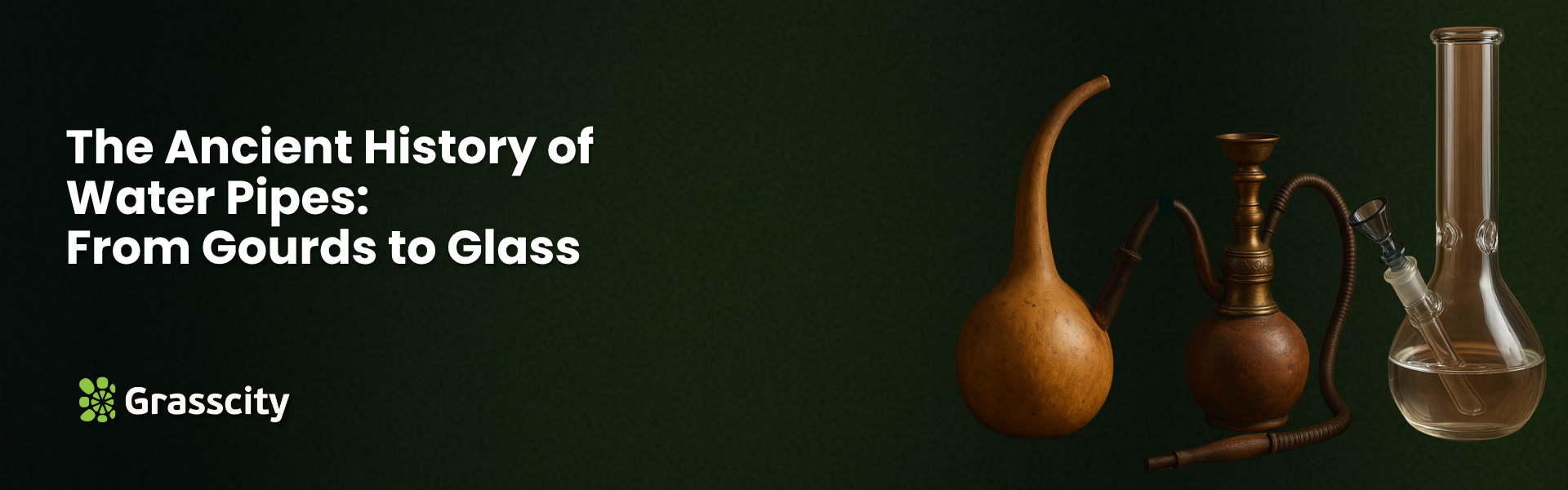
The first water pipes were invented in ancient Africa and Asia, using naturally hollow and water-resistant materials like gourds, bamboo stalks, and coconuts as functional smoking devices.
Ever stop and really look at the water pipe sitting on your coffee table? It feels like a modern invention, a piece of scientific art born in our time. But we've been around long enough to know that most things have a deeper story, and this one is a 6,000-year-old epic you probably haven't heard. We're going to take you on that journey, from the clay pipes that built the first cities to the solid gold treasures of ancient kings. This isn't just about the history of smoking; it's a wild story of human ingenuity, survival, and ritual, all leading to the piece you know today.
What Were the First Water Pipes Made From?
The first water pipes weren't meticulously crafted in a workshop; they were cleverly discovered in the natural world. Long before pottery or glass, ancient people used their ingenuity to adapt organic, "ready-made" materials into functional smoking devices. This was innovation through observation, applying the simple principle of water filtration to whatever the local environment provided.
-
Gourds and Coconuts: In parts of Africa and the Americas, dried gourds and coconuts were the obvious choice. Their naturally hollow, water-resistant bodies required very little work to become a water chamber, especially since these plants were already used to make bowls and containers.
-
Bamboo Stalks: Across Asia, bamboo was the perfect ready-made material. Its hollow, segmented stalks could easily be turned into both the pipe's body and its stem. In fact, the modern word "bong" is believed to come from the Thai word "buang," which referred to exactly this kind of bamboo smoking pipe.
-
Animal Horns: In areas where large animals were common, hollowed-out horns from creatures like water buffalo provided a durable and convenient option for the main chamber.
The reason you won't find these original pieces in a museum is simple: they weren't built to last. Since they were made from organic materials, these first pipes have long since decomposed, leaving historians to piece together their story from the more durable artifacts that came later.
Who Invented the First Water Pipe?
For years, based on the global popularity of the hookah and the origins of the word 'bong,' most people assumed the water pipe story started in Asia. The water pipe is an African invention, correcting a long-held misconception about its origins. This isn't just a theory; it's based on solid archaeological finds.
While many once assumed the water pipe story started in Asia, historical discoveries suggest an African origin. Based on ancient artifacts, some historians believe that early water pipes were first developed in Africa, challenging long-held theories about their beginnings. These early smoking devices show a long history of human ingenuity, cementing Africa's foundational role in the story of the bong.
What is the Oldest Water Pipe Ever Found?
The history of the water pipe takes a fascinating turn from simple, organic materials to precious metals. Some of the most stunning ancient water pipes known today were crafted from solid gold, reportedly belonging to Scythian royalty and dating back over 2,400 years.
These were not everyday tools but ornate treasures intended for nobility, highlighting their importance in ancient rituals. Their existence improve the water pipe from a folk instrument to an object of power and status, famously described by ancient historians like Herodotus who documented the Scythians' elaborate smoke rituals.
How Did the Modern Hookah Evolve?
While the bong was being perfected for personal or royal rituals, a more social cousin—the hookah—began its own journey across the globe. Its story is one of cultural exchange and artistic refinement, a path you can trace directly along the bustling Silk Road trade routes.
-
16th Century Mughal India: The story begins here, where a Persian physician named Hakim Abu'l-Fath Gilani invented the device for Emperor Akbar. The goal was to alter the smoke's temperature and texture by passing it through water. These first versions, called the huqqa, were simple and often used a coconut shell for the water base.
-
The Persian Empire: As the huqqa traveled west, it was adopted and refined in Persia. Now known as the qalyan, artisans began crafting it from more durable materials like wood and metal. It moved beyond being a novelty for the elite and became a fixture of broader social life.
-
The Ottoman Empire: The hookah reached its artistic and cultural peak in Turkey. Here, it was called the nargile and was transformed into a masterpiece. Craftsmen created the iconic shape we know today, using ornate glass bases and intricate brass work. The nargile became the cornerstone of café culture and a powerful symbol of hospitality, trust, and even diplomacy.
When Were Glass Pipes Invented?
After thousands of years of gourds, gold, and clay, the story of the water pipe makes its final, important leap into the material we know best today: glass. This is a surprisingly modern chapter, marking the moment when ancient tradition finally fused with modern science and counter-culture art.
The Borosilicate Breakthrough: The Science of Modern Pipes
For a glass pipe to be practical, it needed more than just artistry; it required a major scientific upgrade. Early glass, known as "soft glass," had a critical weakness: it was terrible at handling rapid temperature changes. This vulnerability to "thermal shock" meant it could easily crack or shatter when heated and cooled repeatedly, making it a poor choice for a smoking device.
The solution came from the laboratory. A new type of glass called borosilicate was developed, which was much stronger and highly resistant to thermal shock. Made famous under the brand name Pyrex, this durable "hard glass" could withstand extreme temperature swings without breaking. This was the single most important technical innovation for the modern pipe. Because this high-performance material was originally designed for lab equipment like beakers and test tubes, it earned a new name in the headshop world: scientific glass.
Who is the Famous Glass Pipe Maker Who Started it All?
The scientific foundation was there, but it took a cultural revolution and one visionary artist to bring the modern glass pipe to life. That artist is Bob Snodgrass, a man widely respected as the "Godfather of Glass." He almost single-handedly pioneered the artistic glass pipe movement and created the culture that surrounds it today.
His legend began when he famously followed the Grateful Dead on tour, selling his unique glass pipes from the back of his van. In doing so, he connected his art directly to a massive, dedicated counter-culture movement that was hungry for new forms of expression. Snodgrass’s most important innovation was the accidental discovery of "fuming." He found that by heating precious metals like gold and silver in the flame, he could let the vapor coat the inside of a pipe. This created stunning, iridescent, color-changing effects that turned clear, clinical scientific glass into a vibrant, psychedelic art canvas.
Frequently Asked Questions
What were the very first pipes made of?
The very first water pipes were made from naturally hollow and water-resistant organic materials like gourds, bamboo, coconuts, and animal horns.
Where did the first smoking pipes originate?
Historical accounts and recovered artifacts suggest that the first smoking pipes, including early water pipes or bongs, originated in Africa.
What is the oldest water pipe ever found?
The oldest known water pipes are a pair of 2,400-year-old solid gold bongs attributed to Scythian royalty.
When were modern glass pipes invented?
The modern artistic glass pipe movement was pioneered in the 1970s and 80s by artist Bob Snodgrass, who fused the use of scientific borosilicate glass with counter-culture art.
What are the most common types of bongs today?
Modern bongs are typically made from scientific borosilicate glass and feature advanced designs, such as stable beaker bongs or percolator bongs that contain features to diffuse the smoke.

![Vape Pen vs. Wax Pen vs. Dab Pen: The Ultimate Comparison [2026]](http://www.grasscity.com/cdn/shop/files/Vape_Pen_vs._Wax_Pen_vs._Dab_Pen_The_Ultimate_Comparison_2026_-cover_1_c2a92a6c-52ce-4718-9151-b95095f147c5.png?v=1773417827&width=1500)


