

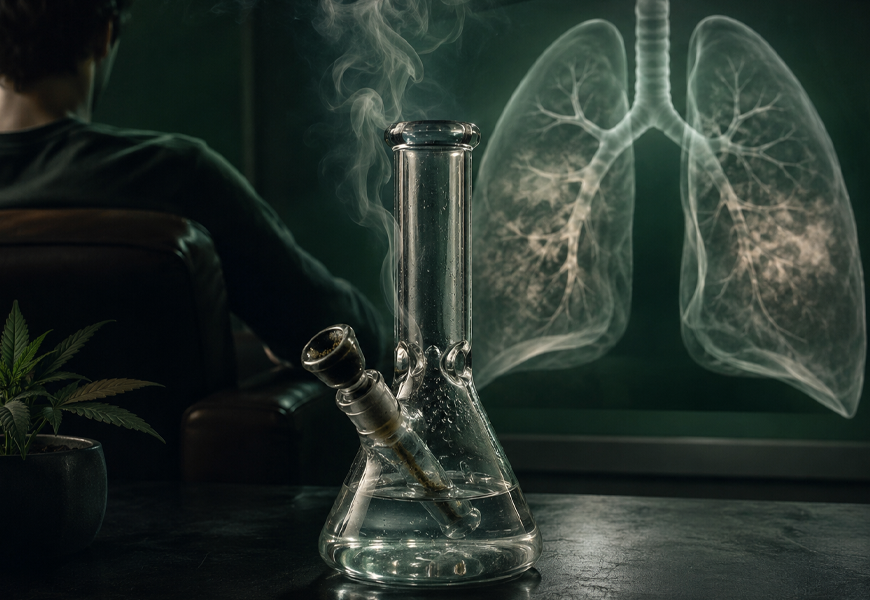
Bong lung isn't an official medical diagnosis. It's a term used to describe respiratory symptoms, chronic cough, shortness of breath, and in some cases unusual lung findings on imaging, reported in a small number of heavy, long-term dry herb smokers. Water filtration cools smoke and reduces some particulates, but it doesn't eliminate the risks of regular smoke inhalation. Here's what's actually documented, and what moderation looks like in practice.
Is Bong Lung an Official Diagnosis?

No. "Bong lung" doesn't appear in diagnostic manuals as a recognized clinical condition. It's a descriptive term that surfaced in medical literature after doctors began documenting a specific pattern in some heavy dry herb smokers:
- Large, air-filled bullae (thin-walled pockets) forming in the upper lungs
- Predisposition to spontaneous pneumothorax a collapsed lung, in some documented cases
- Chronic cough and shortness of breath in long-term, heavy users
These findings come from case reports and small case series, not large-scale population studies. That distinction matters: a case report documents what happened to one or a handful of patients, while a large study can establish how common something actually is across a population. Bong lung has plenty of the former and very little of the latter.
What Case Reports Have Found
The term traces back to a 2000 case series in Thorax, where researchers described four men with large upper-lung bullae and significant dry herb exposure, three of whom had minimal traditional smoking use (Johnson et al., Thorax, 2000). A 2010 case report in the Journal of Medical Case Reports documented a 23-year-old man with cystic fibrosis whose bong-related lung findings included large bullae and reduced lung function on discharge (Gao et al., J Med Case Rep, 2010).
A 2024 review in Respirology puts these findings in context: there's no epidemiological evidence, from case-control or cohort studies using CT scans, that dry herb smoking causes emphysema in the general population of users, and bong lung likely only occurs in susceptible individuals after very extensive dry herb use (Hancox, Respirology, 2024).
The same review also notes there's no evidence this pattern is specific to bongs over other smoking methods, the name is more historical than diagnostic.
In short: the documented cases are real, but they represent rare, severe outcomes in heavy long-term users, not a typical or likely outcome for casual or moderate smokers.
Does Water Filtration Help?
Partially. Water filtration cools smoke and filters out some larger particulates and water-soluble compounds, which is part of why bong hits often feel gentler on the throat than a dry pipe or joint. What it doesn't do:
- Remove tar or other combustion byproducts
- Eliminate deep lung exposure to smoke
- Prevent the deep inhalation and breath-holding patterns some researchers link to bullae formation
So filtration reduces some irritation without eliminating risk. It changes the experience of the hit more than it changes the underlying exposure from combustion.
Practicing Moderation
Since the documented risk concentrates in heavy, long-term, frequent use, moderation is a genuinely reasonable takeaway, not just a hedge:
- Take breaks. Regular tolerance breaks reduce cumulative exposure over time.
- Watch your frequency, not just your dose. Case reports consistently involve years of heavy daily use, not occasional sessions.
- Consider lower-combustion methods for heavy use. Portable vaporizers heat material without full combustion, which reduces some of the byproducts tied to smoke inhalation.
- Keep your gear clean. A well-maintained bong won't offset combustion risk, but it does cut down on additional contaminant exposure from mold or stagnant water, see our deep cleaning guide for a full routine.
- Know your own limits. Our guide to responsible bong use and etiquette covers the moderation side of things in more depth.
If you're deciding what to buy or upgrade, our bong buying guide and percolator guide can help you weigh filtration options across Grasscity's bongs collection, though it's worth remembering that no bong design has been shown to eliminate combustion risk entirely.
Medical disclaimer: This article is for general information only and is not medical advice. It does not diagnose, treat, or replace consultation with a licensed healthcare provider. If you have respiratory symptoms, persistent cough, shortness of breath, or chest pain, or concerns about your smoking habits, talk to a doctor.


